Wayanad
Wildlife sanctuary
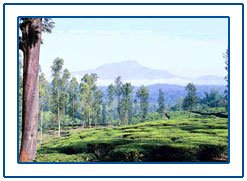
Introduction :
Established in 1973, the Wayanad Wildlife
sanctuary is contiguous to the protected area network of Nagarhole
and Bandipur of Karnataka on the north-east and Mudimalai
of Tamilnadu on the south-east. Rich in bio-diversity, the
sanctuary is an integral part of the Nilgiri Biosphere Reservem,
Which has been established with the specific objective of
conservating the biological heritage of the region. Interestingly,
it was from here that Pazhassi Raja fought valiantly against
the British.Consisting entirely of notified reserve, the sanctuary
is very rich in fauna and flora. The management of the sanctuary
lays emphasis on scientific conservation with due consideration
to the general lifestyle of the Tribals and others who live
on the frings of the forest.
Topography
:
Gently undulating with occasional hillocks, the highest peak
is Karottimala (1158m).
Climate
:
The tract receives fairly reasonable amount of rain, most
of which is received during June to August. March, April and
May are warm.
Forest
Types :
Most of the forests are of the south Indian moist deciduous
type. There are, however, a few patches of west coast semi
evergreen forests. About 110 sq.kms of the sanctuary is under
plantations of teak, eucalyptus. And grevelia.
Flora
:
In the moist deciduous forest, maruthi, karimaruthi, rosewood,
venteak, vengal, chadachi, mazhukanjiram, bamboo etc grow.
In the semi-evergreen patches Veteria indica. Lagerstroemia,
Lanceolata, Termianalia paniculata etc are common.
Fauna
:
The animal population of the sanctuary is varies. Elephant,
tiger, Panther, jungle cat, civet cat, monkeys, wild dog,
bison, deer, bear, etc. inhabit the sanctuary. Reptiles like
monitor lizard and a variety of snakes are seen. Peacock,
babblers, cuckoos, owl, wood pecker and jungle fowl are only
a few among the different types of birds seen in the area.
Among the animals, elephant
occupies the prime position. Interstate seasonal migration
of elephant is common.Tiger population of the sanctuary is
fairly good. Frequent sightings are reported from Tholpetty,
Rambur and Mavinhalla areas.
Travel
Information :
Good roads connect the sanctuary with Kozhikode, Mysore and
Ootty. They are also connected by rail and are within 110
kms from the sanctuary. The nearest airport is Kozhikode.
Visitors can halt at Sultan Bathery or Mananthavadi and visit
the sanctuary Government rest houses and private lodges offer
accommodation.

|