Jaipur
[Rajasthan]
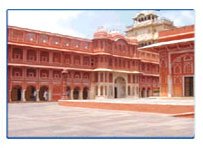 Jaipur
was founded by Maharaja Jai Singh II (1693-1743), is the capital
of Rajasthan. It is a major attraction for the first-time visitor.
Jaipur is surrounded on all sides by rugged hills, crowned with
forts & enclosed by embattled walls.
Jaipur
was founded by Maharaja Jai Singh II (1693-1743), is the capital
of Rajasthan. It is a major attraction for the first-time visitor.
Jaipur is surrounded on all sides by rugged hills, crowned with
forts & enclosed by embattled walls.
The Old City (Known as the Pink City) is a great
place to wander around. The whole city was painted in Pink colour
by Maharaja Man Singh II when Prince of Wales, later Edward VII,
visited Jaipur in 1876 AD. Today, every home within the city is
obliged by law to maintain its facade. It is a very well planned
city laid out in a grid pattern and was designed by a young Bengali
engineer and scholar by the name "Vidyadhar Bhattacharya".
Jaipur was and remains the only city in the
world, symbolising the nine divisions of the universe, through
nine rectangular sectors sub-dividing it. Jaipur is a royal city & this is its most noticeable aspect, small buildings & festivals testify it.
Jaipur & its surroundings are rather like
an endless museum. The city also offers an endless variety of
crafts. Jewellers here still fashion the beautiful enamel-on-gold
pendants, studded on the reverse with precious stones or pearls
& turquoise that one sees in miniature paintings. Jaipur's
lacquer bangles are famous all over the world.
Places of Interest
(Jaipur)
Amer Palace
High on the rugged hills outside of town sits ancient forts, including
Amer (often called the Amber Fort), where the Jaipur royal house
held court for seven centuries. Visitors ridding painted elephants
can ascend to the fort to see magnificent gateways, courtyards,
pavalions, and a gliterring chamber of inlaid mirrors.
Hawa Mahal
Jaipur's most famous landmark is the Palace of the Winds or Hawa
Mahal, a fantasia of 1953 ornate of windows set in a rose-colored
five storey facade. The palace , tier upon tier of curved arch
surmounting fairy casements with "jali", lattice work
screens. From here the ladies of the court could look out at festive
processions without jeopardizing their modest seclusion..
Jal Mahal
A picturesque palace admist the Man Sagar Lake. It is Jaipur's
lake palace surrounded with water. It is built for royal duck
shooting parties.
Jantar Mantar
The architectural astronomical instruments of 18th century Rajasthani
king named Jai Singh contained in an amazing, three-storey-high
complex known as Jantar Mantar.
City Palace
A pride of peacocks adorn an ornate doorway in Jaipur's City Palace.
Palace retainers stand at attention as in the past when Jaipur
Court was headquartered here. The palace is now a fine museum.
It houses a remarkable collection of textiles, paintings, manuscripts,
and extraordinary weapons. On display there are two huge urns
of silver, said to be the largest silver vessels in the world.
Nakkarkhana-ka-Darwaza, the imposing gateway of the City Palace
guarded by stone elephants, is monumental.
Jaigarh
The western skyline is dominated by the extensive walls, watch
towers and gateways of Jaigarh built by Jai Singh in 1726. It
is one of the few military structures of medevial India preserved
almost intact, containing palaces , gardens, open and covered
reservoirs, a granary, an armoury, a canon foundary and several
temples. It is the royal treasury for several years. The world's
largest cannon on wheels is to be found here. The fort has its
own museum and provide an excellent view of Amer Palace.
Nahargarh Fort
Built in 1734, the Nahargarh Fort lies north-west of City Palace
and provides some stunning views of the city down below both during
daytime and night.
Sisodia Rani Ka
Bagh
Has beautiful gardens, fountains, pools & some magnificent
pieces of sculpture.
Albert Hall Museum
It exhibits include a natural history collection, models of yogis
adopting various positions, tribal ware, dioramas depicting Rajasthani
dances and sections on decorative arts, costumes, drawings and
musical instruments
Nearby Attraction
Bairath
An important historical place with the excavated remains of a
circular Buddhist temple - unique in Rajasthani and the earliest
known temple in India. Bairath also has relics of the Mauryan,
Mughal and Rajput periods. A mint constructed by Akbar, a beautiful
Mughal garden and a remarkable monument with painted chhatris
and wall built by Jahangir are other attractions.
Gaitor
The cenotaphs of the royal family are at Gaitor, just outside
the city walls. The cenotaph of Maharaja Jai Singh II is particularly
impressive. The cenotaphs of the maharanis of Jaipur are on Ambr
road, midway between Jaipur and Amber. Nearby is the Jal Mahal
(water Palace), in the middle of the lake and reached by a causeway.
Galta
The temple of the sun god at Galta is 100m above Jaipur to the
east, a 2.5km climb from Surajpol. A deep, temple-studded gorge
stands behind the temple and there are good views over the surrounding
plains.
Ramgarh Lake
A huge artificial lake created by constructing a high bund amidst
tree covered hills. While the temple of Jamwa Mata and the ruins
of the old fort are some of its antiquities, its beautiful landscape,
especially during in oils pools, makes it an idyllic picnic spot.
Samode
The beautiful Samode Palace, has been rebuilt and renovated and
provides a fine example of the Rajput haveli architecture and
is an ideal spot for outings. The highlight of the building is
the exquisite Diwan-i-Khas, which is covered with original paintings
and mirrorwork.
Sanganer
This small town is entered through the ruins of two ' Tripolias
' or ' Triple-gateways '. The town has a ruined palace and a group
of Jain temples with fine carvings. Entry to the temples is restricted.
The town is an important centre for craft, industry and produces
some of the finest hand printed textiles from units of block and
screen printers. This textile is popular all over the country
and abroad. It is noted for its hand printed handloom industry
using simple techniques.
Vidyadhar's Garden
Nestled in a narrow valley, this beautiful garden was built in
honour of jai Singh's chief architect and town planner.
Best Season
September-March
Languages
English, Hindi, Rajasthani.
Travel Information
Air : There are flight
connections to Delhi, Kota, Jodhpur, Udaipur, Aurangabad, Mumbai
and Ahmedabad.
Rail : An excellent
connection from Delhi is Shatabdi Express which provides a fast,
air-conditioned rail service. Other connections to Jaipur are
from Bikaner, Jodhpur, LJdaipur, Ahmedabad, Secunderabad, Agra,
Lucknow, Mumbai and Calcutta. Some important train connections
are : Marudhar Express (Varanasi-Jaipur-Jodhpur); 9770 Express
(Jaipur-Purva), .Gujarat Mail (Mumbai-Jaipur-Delhi Sarai Rohilla);
Shatabdi Express (New Delhi-Jaipur-Ajmer); Superfast Express (Delhi
Sarai Rohilla-Jaipur); Mandore Express (Delhi Sarai Rohilla-Jaipur-Jodhpur);
Intercity Express (Jaipur-Delhi Sarai Rohilla); Chetak Express
(Udaipur-Jaipur-Delhi Sarai Rohilla); Ahmedabad Mail (Delhi Sarai
Rohilla-Jaipur-Ahmedabad); Jodhpur Mail (Marwar-Jaipur-Delhi Sarai
Rohilla).
Road : A convenient
mode of travel to Jaipur is by road, through a network of comfortable
tourist buses. Rajasthan Roadways runs excellent regular service
of AC and Deluxe Coaches from Delhi (From Bikaner House, Pandara
road and ISBT, Kashmeri Gate) Some Road distances are Delhi 259
km, Udaipur 405 km, Jodhpur 336 km, Ahmedabad 657 km.
Local Transport
Unmetered auto-rickshaws, buses, cycle-rickshaws. The Rajasthan
State Roadways operates regular bus service to Amer Palace and
around the city.