Jhunjhunu
[Rajasthan]
Jhunjhunu was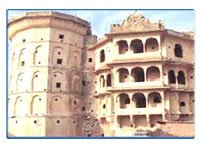 founded by Kaimkhani Nawabs in the middle of the 15th century,
and remained under their control until it was taken by the Rajput
ruler Sardul Singh in 1730 AD, which lasted till the Indian independence.
It was in Jhunjhunu that the British based their Shekhawati brigade,
a troop raised locally in the 1830s to try to halt the activities
of the dacoits (bandits).
founded by Kaimkhani Nawabs in the middle of the 15th century,
and remained under their control until it was taken by the Rajput
ruler Sardul Singh in 1730 AD, which lasted till the Indian independence.
It was in Jhunjhunu that the British based their Shekhawati brigade,
a troop raised locally in the 1830s to try to halt the activities
of the dacoits (bandits).
They were largely local petty rulers who had
decided it was easier to become wealthy by pinching other peoples’
money than by earning their own. Jhunjhunu is one of the largest
towns of Shekhawati and is the current district headquarters.
It has some of the region’s most beautiful buildings and
should not be missed. The artistically painted havelis of Muragh
Das Modi, and the Khaitans are spellbinding.
Places Of Interest
(Jhunjhunu)
The Khetri Mahal
A fine minor palace dating back to around 1760 AD. It has very
elegant lines and is architecturally the most sophisticated building
in the region, though not in the greatest condition.
The Modi and Tiberwala
Havelis
Both in the main bazaar, these are covered with murals, and the
latter one is particularly interesting. The town also has a number
of chhatris' and wells.
Bihari Ji Temple
It is a temple in Jhunjhunu, which is immensely popular for its
antique paintings. Sri Biharji Temple is from a similar period
and contains some fine murals, although these too have suffered
over the years.
Shri Ranisatiji
Mandir
Located in Jhunjhunu, it is one of the exemplary temples in India.
It is one of the ancient pilgrimages in the country which is a
historic, unprecedented masterpiece affording a panoramic view.