Sarnath
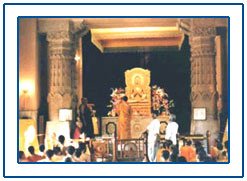
Sarnath is located eight
km from Varanasi in the northern Indian state of Uttar Pradesh.
It is famous as the place where the Buddha
first preached his message after attaining nirvana.
climate:
Due to its location near the Tropic of Cancer, Sarnath enjoys
a comfortable winter but a hot summer. During winter, the
mercury can dip to as low as 10°C at night and the daytime
temperature remains around 20°C.
Summer brings a less comfortable
weather situation. Begining in April and continuing through
June, it is extremely dry and daytime temperatures often climb
up to 45°C.
In late June or early July,
the monsoon season brings torrential rains and high humidity.
Fortunately, the temperatures normally remain under 37°C,
although uncomfortably humid.
History:
Sarnath derives its name from Saranganatha
(Lord of the Deer). After the Buddha attained enlightenment
in Bodh Gaya, he came to Sarnath. Here in the Deer Park, he
delivered his first sermon or set in motion the Wheel of Law
(Maha Dharmachakra Pravartan.). On the day before his death,
the Buddha named Sarnath along with Lumbini, Bodh Gaya and
Kushinagar as the four places that his followers should consider
sacred.
The Emperor Ashoka, who
spread Lord Buddha's message of love and compassion throughout
his vast empire, visited Sarnath around 234 BC and constructed
a stupa here. Several Buddhist structures were built at Sarnath
between the 3rd century BC and the 11th century AD and today
this place has the most expansive ruins among the places related
to the Buddha.
Explorations during a recent
Japanese-funded UNESCO project have yielded this "biggest
Buddhist settlement in all of Central India." The remains point to monasteries of enormous proportions.
Earlier, eight structures had been identified. Now, 14 more
monasteries and 23 stupas have been found. The Archaeological
Museum here as well as the Chinese and Tibetan Temples are
all worth a visit.
Places
To See:
Believed to have been built in 500 AD, the Dhamekh
stupa, the largest in the region, marks the spot
where the Buddha proclaimed his faith in front of his first
five followers. The lower portion of this tall cylindrical
stupa has fine floral carvings. It houses a stone slab with
Buddhist inscriptions on it dating back to the 6th century
BC. The sprawling green lawns around it provide the right
environment to meditating monks.
The main excavation site
is a vast expanse of low lying structures and standing amidst
them one can view the various facets of Buddhist history,
its interesting twists and turns, the rise and fall of empires
and kingdoms. One can witness the ancient relics of Buddhist
art, which was designed to communicate the message of the
Buddha through signs and symbols. The earliest and most important
relic is found in the Ashoka pillar that was erected in 250
BC. Four lions representing the spirit of India sit back to
back with a wheel between them. The original piece is in the
Sarnath archaeological museum.
As one explores the open
complex of ruins, one can find monasteries dating back to
different periods, reflecting different tenets of Buddhism.
Kumar Devi was a Buddhist queen of Kannauj, who built perhaps
the last of the great monasteries. Remnants of its basement
and halls are visible here.
The dilapidated remains
of the Choukhandi Stupa belonging to the
Gupta period are a reminder that this is the place where the
Buddha was reunited with his five disciples, who had previously
deserted him. Standing on a terraced rectangular plinth, the
Stupa is capped by an incongruous octagonal Mughal tower built
by Emperor Akbar to commemorate his father's visit to the
place.
The Mulagandha Kuti
Vihar was built in 1931 by the Mahabodhi Society.
The entrance of the vihar is dominated by a huge bell, a gift
from Japan, and the interior contains a beautiful life-size
golden image of the Buddha and colorful murals and frescoes
painted by a Japanese artist.
The Sarnath Archeological
Museum houses the superb Lion capital of the Ashokan
Pillar. This symbol has been adopted as the national emblem
of modern India.
Buddhists from various countries
have built temples, each one unique in that it is built according
to the architectural style of the country. Life in each of
these temples-Chinese, Thai, Korean, Tibetan, Vietnamese,
Sikkimese, or Burmese-revolves around cleaning the temple,
meditating, reading holy books, teaching and offering food
to the hungry and help to the needy.
Nearby
Places:
Varanasi is the most important place near
Sarnath and a regular stop for the tourists headed for Sarnath.
The city is famous for its temples, ghats, lanes, and most
importantly its religious and cultural significance in the
Hindu society.
Sarnath is a part of one
of the major tourist circuits of India-the Buddhist circuit-and
is linked to Bodhgaya, Rajgir, Nalanda, Kushinagar, and Lumbini.
Travel
Information:
By Air: The
nearest airport is Babatpur 30 km away from where one can
take daily flights to Delhi, Calcutta, Bhubaneswar, Kathmandu,
and Patna.
By
Rail:Sarnath is a halt on the Northern Railway
network and several of the trains, which cross Varanasi, stop
here. From Varanasi direct trains are available for almost
all the major cities of India.
By
Road: Sarnath is 9.6 km by road from Varanasi,
and is linked by a regular bus service. One can also hire
a taxi from Varanasi.
|