Vaishno
Devi
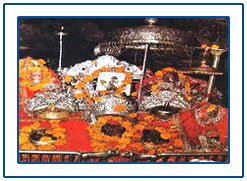 Since
times immemorial, lakhs of pilgrims every year have been visiting
the holy shrine of Vaishno Devi from all
corners of the globe. Considered to be one of the holiest
Hindu shrines in North India, the cave is the abode of the
Mother Goddess, who is worshipped here in the forms of Maha
Kali, Maha Saraswati, and Maha Lakshmi. As the Goddess welcomes
her devotees every day, the number of pilgrims keeps on swelling
year after year. Vaishno Devi is not merely a shrine; it is
a site of spiritual cleansing and resuscitation for the heart
that truly seeks the divine. Since
times immemorial, lakhs of pilgrims every year have been visiting
the holy shrine of Vaishno Devi from all
corners of the globe. Considered to be one of the holiest
Hindu shrines in North India, the cave is the abode of the
Mother Goddess, who is worshipped here in the forms of Maha
Kali, Maha Saraswati, and Maha Lakshmi. As the Goddess welcomes
her devotees every day, the number of pilgrims keeps on swelling
year after year. Vaishno Devi is not merely a shrine; it is
a site of spiritual cleansing and resuscitation for the heart
that truly seeks the divine.
The Vaishno Devi shrine
is nestled in the Trikuta Mountain. It lies
61 km north of Jammu in the northern state of Jammu and Kashmir.
Perched at a height of 5,200 feet above the sea level, Vaishno
Devi is a cave in the lower Himalayas. Katra, the town at
the foot of the Trikuta hills is the base camp for the Vaishno
Devi shrine. Katra is 48 km from Jammu, 650 km from Delhi
(via Una), 520 km from Udhampur, 410 km from Chandigarh and
80 km from Patnitop The shrine is visited all through the
year, but the path is difficult during the winters when the
route is often blocked by snowfall.
The legend goes that more
than 700 years ago, Vaishno Devi, a devotee of Lord Vishnu,
used to pray to Lord Rama and had taken vow of celibacy. One
day, Bhairon Nath, a demon-God, saw her and gave chase. The
Goddess felt thirsty at Banganga and shot an arrow into the
earth from where water gushed out. Charan Paduka,
marked by the imprints of her feet, is the place where she
rested. She then meditated in the cave at Ardhkanwari.
It took Bhairon Nath nine months to locate her. Mata Vaishno
Devi then blasted an opening at the other end of the cave.
She assumed the form of Maha Kali and cut off Bhairon Nath's
head, which fell at the place where the Bhairon Temple is
now located. The boulder at the mouth of the holy cave, according
to the legend, is the petrified torso of Bhairon Nath who
was granted divine forgiveness by the benevolent Mata in his
dying moments.
THE
SHRINE:
The holy cave shrine of Vaishno Devi is said to have been
built by the five Pandavas. The length of the cave is about
98 ft. The symbols of a large number of gods and goddesses
of the Hindu pantheon can be seen here. At the mouth of the
original tunnel to the holy cave can be seen the symbols of
Vakra Tunda Ganesha, Surya Dev and Chandra Dev. When one crawls
into the cave through the tunnel, he/she crosses over the
Dhadh of Bhairon Nath. The symbol of Lord Hanuman, called
Launkra Beer, can also be seen and the pilgrims have to wade
through water beyond the Launkra Beer point. Twenty-three
feet beyond Launkra Beer, on the upper left-hand side, the
roof of the cave flares out and the weight of this overhang
appears to be resting on the innumerable heads of Shesh Nag.
Immediately below Shesh Nag can be seen the symbols of Shankh,
Chakra, Gada and Padam. Higher up, almost touching the ceiling
of the cave, are the symbols of the five Pandavas, the Sapt
Rishi, the udders of the divine cow, Kamadhenu, Brahma, Vishnu,
Shiva and Parvati.
Nearby
Places:
The Deva Mai temple is about
three miles short of Katra town. Many devotees treat it as
a very holy site and go there to perform paeans.
The Holy Cave of Shiv Khori
is the abode of Lord Shiva, situated at a distance of 70 km
from Katra. The cave is a real wonder to be seen and measures
nearly a kilometer in length with a four-feet-high naturally
formed Shiv-lingam at the heart of the sanctum sanctorum.
A few miles away from Katra
is Pindian at the foot of the Trikuta range. This spot is
also dedicated to Vaishno Devi.
The temple of Baba Dhansar
is dedicated to Lord Shiva and is located at a distance of
about 15 km from Katra on way to Salal Dam. Here, a huge spring
emerges from the rocks in a thick grove of trees and forms
a number of small rapids before flowing into the holy rivulet
that merges with the Chenab River.
The sacred shrine of Dera
Baba Banda is situated at a distance of 30 km from Katra.
It is a major Hindu-Sikh pilgrimage center. According to local
legend, Baba Banda Bairaagi was Guru Gobind Singh’s
favorite ‘Saint Soldier’ who constructed a Gurdwara
on the banks of river Chenab, where he spent his last days.
The legendary hero Baba
Jitto's temple is situated at village Aghar Jitto, which is
just 5 km from Katra town, on the Katra-Reasi Road. Baba Jitto,
who was a peasant by profession, was a staunch devotee of
the Goddess Vaishno Devi. He is remembered amongst the peasant
class for his revolutionary act of opposing the landlord's
oppression and subsequently laying down his life for this
cause. A big fair called 'Jhiri Mela' is still conducted to
commemorate the martyrdom of Baba Jitto at a place called
'Jhiri', which is 20 km from Jammu.
WHAT
TO DO:
The Shrine Board at Katra has set up a number of counters
for issuing ‘Yatra Slips' to the visitors. Only 20,000
visitors are allowed to cross the Banganga checkpoint daily.
If the prescribed number of slips has already been issued,
the pilgrims are issued with ‘Waiting Slips'. After
obtaining the slip, the pilgrims must clear the Banganga checkpoint
within a period of 6 hours from the time of issue. One should
collect his/her belongings before going to this shrine, as
the path of return is different. The return path from the
Bhairon Shrine joins the main path at Sanjhi Chhat and is
13 km long.
The ‘bhaint'
(offerings) for the goddess must include coconut, mauli (sacred
thread), red ‘chunni' (headscarf) with gold/silver trimmings,
dry fruits, bangles, and incense and vermilion powder. Other
offerings include ‘mehndi' (henna), ‘supari' (areca
nut) and ‘chattar' (umbrella). There are facilities
for buying these at fixed prices.
Visitors would do well to
have non-leather walking shoes, cotton bags, torches, caps
and walking sticks. Most of these items can be hired at Katra.
Visitors should leave all their leather belongings and other
heavier baggage at Katra.
Travel
Information:
Vaishno Devi Temple can be reached after making a steep 13-km
trek from the road head at Katra, the town at the foot of
the Trikuta hills. Several porters and ponies are available
at Katra on hire.
Jammu is the nearest airport.
Jammu's civil airport at Ranibagh is 9 km from the city center.
Alliance Air, a subsidiary of Indian Airlines, runs flights
to and from Delhi, Srinagar and Leh.
Jammu is the nearest railhead,
which lies on the other side of the Tawi River. Jammu is very
well connected with all major destinations in India by rail.
Direct express trains link it with Mumbai, Delhi and Calcutta.
Taxis and buses are available
from Jammu to Katra at frequent intervals. Regular bus services
to Katra are also available from a number of north Indian
towns like Tarn Taran, Amritsar, Jallandhar, Ludhiana, Patiala,
Chandigarh, Delhi, Jwalaji and Srinagar.

|