Sravasti
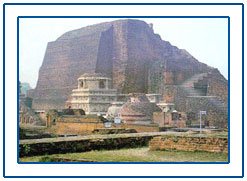
Sravasti is situated in the north Indian
state of Uttar Pradesh around 176 km off Lucknow. It is a
part of the Buddhist circuit that encompasses
the states of Uttar Pradesh, Bihar, and Nepal. There are good
rail and road networks that connect this small place with
the other places in the region.
Climate:
Sravasti, due to its location in the Gangatic plains and proximity
to the Tropic of Cancer, enjoys a comfortable winter but a
really hot summer. In the winters, the night temperature can
go down to around 10°C and the day temperature to 20°C.
October-November and February-March are almost always comfortable
and sunny. Begining in April and continuing through June,
it is extremely dry and the daytime temperature often reaches
45°C. In late June or early July, monsoon season brings
torential rains and high humidity.
History:
During the time of Sakyamuni, a rich and pious merchant named Sudatta lived in Sravasti. While on a visit
to Rajgir, he heard the Buddha's sermon and decided to become
the Lord's disciple. But he was caught in a dilemma and asked
the Lord whether he could become a follower without forsaking
worldly life. To his query, the Buddha replied that it was
enough that he followed his vocation in a righteous manner.
Sudatta
invited the Buddha to Sravasti and began to look for a suitable
place to build a vihara. A beautiful park at the southern
edge of Sravasti attracted his attention. The park belonged
to Jeta, son of King Prasenjit of Sravasti. Jeta demanded
that Sudatta cover the entire park with gold coins. Sudatta
painstakingly paved every inch of the land with gold. Then
Jeta said that since the trees were left uncovered they belonged
to him. But finally, he had a change of heart and donated
valuable wood to build the vihara. The park came to be known
as Jetavana Vihara in recognition of Prince
Jeta's donation to the sangh.
Buddha
spent 25 years living in the monastery of Jetavana. Many Vinaya
rules, Jatakas and Sutras were first discussed at this place.
The Buddha is supposed to have astonished rival teachers by
performing miracles at Sravasti. It is said that it was in
Sravasti that the Buddha transformed Angulimal from a dacoit
into a Buddhist monk. He also delivered many important sermons
here. King Ashoka erected two pillars 21 meters high on either
side of the eastern gateway of the Jetavana monastery. Sravasti
was a flourishing center of learning during the Gupta period.
When the famed Chinese traveler Hiuen Tsang visited this site,
he found several damaged stupas and ruins of monasteries and
a palace.
Places
to See:
Sravasti has two villages, Sahet and Mahet. From the Balrampur-Sravasti
road one can enter Sahet, which is spread over an area of
400 acres and has a number of ruins. A little north of Sahet,
towards the Rapti River, is the ancient fortified city of
Mahet. The entrance to the mud fortification of Mahet is constructed
in a beautiful crescent shape. Though an ancient structure,
its five gates and walls are still visible. Pakki Kuti, Kuchhi
Kuti and many other stupas tell the story of the great monasteries
that once stood here.
Remnants
of Jetavana, a splendid monastery with inscriptions dating
back to the 12th century, is thought to be one of the favourite
sites of the Buddha. Emperor Ashoka is also said to have visited
this site. There is a sacred pipal tree here, which is a sapling
from the original Maha Bodhi tree under which the Buddha had
attained nirvana. Today, Jetavana has two monasteries, six
temples and five stupas. One temple was built by the monk
Ananthapindika and called Gandhakuti. This is the most sacred
temple in Jetavana since the Buddha is believed to have lived
at this spot.
Sravasti
was also under the influence of Lord Mahavira the last Jain Tirthankar, and the splendid Shwetambara temple
here attracts thousands of Jain pilgrims. The Sobhnath Temple
is believed to the birthplace of the Jain Tirthankar Sambhavnath.
Nearby
Places:
The Devi Patan Temple is located some 28
km from Sravasti. It is one of the most important Shaktipeeths
in the region, revered by Hindus in India and Nepal.
Sankissa is the place where the Buddha descended from heaven along
with Lord Brahma and Devaraj Indra after giving a discourse
to his mother, Mayadevi who had died soon after giving birth
to him. Emperor Ashoka erected a pillar with an elephant capital
to mark this holy spot. Sankissa is situated on the banks
of river Kali and is most easily accessible from Agra, which
is 175 km away. The nearest railhead is Pakhna, 11.5 km away.
Travel
Information:
By Air: The nearest airport from Sravasti
is Lucknow, 176 km away. One can take flights for other cities
of India such as Delhi, Mumbai, and Varanasi from Lucknow.
By
Rail: The nearest railway station from Sravasti
is Gainjahwa, on the Gonda-Naugarh-Gorakhpur loop line. Gonda
and Gorakhpur are connected to the other cities in India through
a fairly good number of trains.
By
Road: Sravasti is connected with Gonda, Gorakhpur,
Lucknow and other cities in central Uttar Pradesh through
state transport corporation buses. The nearest large town
from Sravasti is Balrampur some 20 km away. |