Vaishali
Vaishali is situated in the eastern
Indian state of Bihar, around 55 km off Patna, the capital
of the state. Vaishali extends from latitude 25° in the
North to longitude 85° in the East. The town, an important
place for both the Buddhists and Jains, is
well connected to other important cities in Bihar by road.
History:
Believed to be the first republic in the
world, Vaishali has taken its name from King Vishal of the
Mahabharat age. He is said to have constructed a great fort
here, which is now in ruins. Vaishali is a great Buddhist
pilgrimage and also the birthplace of Lord
Mahavira. It is said that the Buddha visited this
place thrice and spent quite a long time here. The Buddha
also delivered his last sermon at Vaishali and announced his
Nirvana here. After his death, Vaishali also held the second
Buddhist Council.
The great Lichchavi clan ruled Vaishali in the sixth century BC, and
the empire extended up to the hills of Nepal. The Lichchavi
state is considered to be the first republican state of Asia. According to the Jataka stories, (Buddhist story
books giving the account of different births of the Buddha),
Vaishali was ruled by some 7707 kings of the Lichchavi clan. Ajatshatru, the great Magadh King, annexed
Vaishali in the fifth century BC and after that Vaishali gradually
lost its glory and power.
Mahavira, the last Tirthankar
of Jainism, was born in Kundupur near Vaishali. The father
of Mahavira was King Siddartha and his mother Trishala was
the sister of King Chetaka of Vaishali. Since the wealth of
his father's kingdom had increased during the pregnancy, the
child was called Vardhaman. He was named Mahavira because
he showed great courage in a very young age. After the death
of his parents at the age of 30, he renounced the world after
fasting for two days under an Ashoka tree in Vaishali.
Vaishali is also famous
as the land of Ambapali, the great Indian dancer who is related
to many folktales. Ambapali was a beautiful and talented courtesan,
who later took sanyas to follow the path of the Buddha.
Places
to See:
Kolhua:
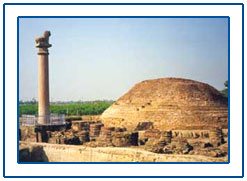
Kolhua is the first important place when one starts exploring
Vaishali. There is a huge iron pillar beside a brick stupa
here, believed to be constructed by King Ashoka. The pillar
was constructed to commemorate the last sermon of the Buddha
here. Near the pillar are ruins of a monastery and a large
tank where the Buddha used to reside during his stay here.
Vaishali
Museum:
The Vaishali Museum is a great place for the tourists interested
in archeology. The museum houses an array of remains discovered
at the various sites in Vaishali. Close to the museum is a
circular tin shed covering the remnants of the stupa, which
once housed the Buddha’s funeral ashes.
At one side of the museum
is the Abhishek Pushkarani or the coronation tank of the Lichchavi’s.
A little distance away is Raja Vishal Ka Garh, an excavated
site believed to be the remains of the ancient parliament
house where the federal assembly of the Lichchavi government
gathered to discuss and regulate the ancient republic.
Bawan
Pokhar Temple:
The Bawan Pokhar Temple, built during the Pala period, stands
on the northern bank of a tank known as Bawan Pokhar and enshrines
beautiful images of several Hindu gods.
Vishwa
Shanti Stupa:
A major attraction in Vaishali is the Vishwa Shanti Stupa
(pillar of peace), one of the newest additions to this important
site. This monument, built on the south bank of the coronation
tank, is one of the highest in the world and has been built
in collaboration with the Japanese government.
Nearby
Places:
Vaishali is a part of the famous Buddhist Circuit comprising
Sarnath, Kushinagar, Bodhgaya, and Kushinagar. Nearby cities
such as Patna, Rajgir, and Bodhgaya are some of the places
worth exploring. Madhubani, around 100 km from Vaishali, is
famous for its paintings by the same name and can be reached
easily by road.
Patna, the capital of Bihar
is quite close by and is also worth a visit. It is one of
the few cities in the world having a long and extremely rich
history, as it was once the capital of the mighty Magadh empire.
Nearby cities such as Rajgir,
Nalanda, and Bodhgaya are very important sites to explore
if one has an interest in Buddhism and the culture and society
during those days.
Four kilometers off Vaishali
is Kundupur, the birthplace of Lord Mahavira. There is a plaque
at the site proclaiming it to be the place where the 24th
Tirthankar of the Jains was born.
Travel
Information:
By Air: The
nearest airport from Vaishali is Patna, 55 km away. One can
take flights for Delhi, Calcutta, Kathmandu, Varanasi, and
Lucknow from there.
By
Rail: The nearest railhead is Hajipur, 35
km, which is well connected to major cities of India like
Delhi, Calcutta, Mumbai, Chennai, and Varanasi by regular
trains.
By
Road: Roads are the most suitable means to
reach Vaishali. There are regular buses for Patna and other
cities of North Bihar from Vaishali. Tourist coaches with
guides are also available from Patna for a tour of Vaishali.

|