Badrinath
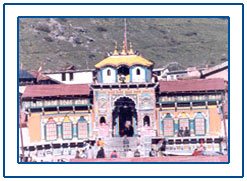 An
old Indian proverb goes, "There are many sacred spots
of pilgrimage in the heavens, earth and the nether world,
but there has been none equal to Badri, nor shall there be." Indians, known for their religious fervor, lay special importance
to this holy town. The etymological root for the name of the
town goes to the Badri Van, where the lush
green Badri trees grow. According to a local myth, the word
badri is derived from the wild berry that Lord Vishnu
(God of the Hindu trinity, entrusted with preserving
the Universe) survived on during his reparation at Badri Van. An
old Indian proverb goes, "There are many sacred spots
of pilgrimage in the heavens, earth and the nether world,
but there has been none equal to Badri, nor shall there be." Indians, known for their religious fervor, lay special importance
to this holy town. The etymological root for the name of the
town goes to the Badri Van, where the lush
green Badri trees grow. According to a local myth, the word
badri is derived from the wild berry that Lord Vishnu
(God of the Hindu trinity, entrusted with preserving
the Universe) survived on during his reparation at Badri Van.
Badrinath
is situated on the right banks of the river Alakananda in the stae Uttaranchal, Badrinath is couched within the two
mountain ranges of Nar and Narayan, with the Neelkanth peak
on the background. This breathtaking sight is itself an enchantment
for tourists and is called the "Garhwal Queen."
It is located in the northern district of Chamoli and the
nearest cities are Rishikesh (300 km), Mussourie and Dehradun.
It is never too hot even in the summers, with night temperatures
falling to as low as 10°C. This makes it a pleasant retreat
from the other tropical places in the country.
Badrinath
the acclaimed abode of Lord Vishnu is one of North India's "Four Holy Temple Cities" or dhams along with Puri,
Rameswaram and Dwaraka. Badrinath is also known as
Tapobhumi (land of meditation and penance) and Bhubaikunth
(heaven on earth). It is situated at an altitude of 3133 meters
above sea level. Besides the main temple itself, the entrance
to the shrine is of special significance. The temple of Badrinathji
remains closed from October to April due to the winter snow,
when temperatures fall to sub-zero degrees.
Before
entering the temple itself, the pilgrims take a holy dip in
the Tapt Kund, where there are thermal springs with natural
curative properties. It is supposed to be the abode of Agni,
the Hindu God of fire. Other famous natural spring sites are
Narad Kund and Surya Kund.
The
pilgrims generally perform the rites of remembrance and reverence
for the departed souls of their near ones in the Brahma Kapal,
a flat platform on the banks of the river Alakananda. A rock
boulder with the impression of Sheshnag, a mythological serpent,
called Sheshnetra, is also a place to visit.
The footprints of Lord Vishnu are present on a boulder called
Charanpaduka, and are of religious significance.
Another important temple is the Mata Murti temple, dedicated
to the mother of Badrinathji.
The
origin of Alakananda River, Alka Puri, is of special interest
to the daring tourists. Satopanth, a triangular lake, is located
at a height of 4402 meters above the sea level and is one
of the sources of the Alakananda River. It is named after
the Hindu trinity-Lord Brahma, Lord Vishnu and Lord
Shiva.
At
the convergence of the rivers, there are pilgrim sites that
are collectively called the Panch Prayag. Devprayag, at the
confluence of Bhagirathi and Alakananda, is famous for its
rock inscriptions and the temples dedicated to Lord Shiva
and Raghunath. Rudraprayag, at the meeting point of Alakananda
and Mandakani, is known for the Rudranath and Chamunda Devi
temples. Nandaprayag is known for the Gopalji temple. Karnaprayag
is the confluence of Alakananda and Pindar rivers and is famous
for its temples dedicated to Uma and Karna. The fifth pilgrimage
spot is Vishnuprayag, at the confluence of Alakananda and
Dhauliganga, where there is a very ancient temple dedicated
to Lord Vishnu, besides the pool of Vishnu Kund.
Another
pilgrim site is the Panch Badri. Yogadhyan Badri, where there
is a meditative idol of Lord Vishnu, Bhavishya Badri, where
there are forests nearby, Adi Badri, where there are 16 temples
and one big temple of Lord Vishnu, are three of the most famous.
Travel
Information:
The nearest airport is that of Jolly Grant, which is about
317 km from Badrinath. Helicopters and small private airlines
are allowed to land there. The nearest railheads are Rishikesh
(297 km) and Kotdwar (327 km). Badrinath is well connected
to all the major tourist spots nearby, namely, Rishikesh,
Hardwar, Kotdwar, Dehradun, and other hill retreats of the
Garhwal and Kumaon region. Delhi is 238 km from Rishikesh.
|