Konarkn
Sun Temple
The
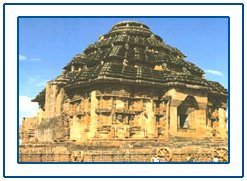
magnificent Sun Temple at Konark is the culmination
of Orissan temple architecture, and one of the most stunning
monuments of religious architecture in the world. The poet
Rabindranath Tagore said of Konark that 'here the language
of stone surpasses the language of man', and it is true that
the experience of Konark is impossible to translate into words.
The
massive structure, now in ruins, sits in solitary splendour
surrounded by drifting sand. Today it is located two kilometers
from the sea, but originally the ocean came almost up to its
base. Until fairly recent times, in fact, the temple was close
enough to the shore to be used as a navigational point by
European sailors, who referred to it as the 'Black
Pagoda'.
Built by King Narasimhadeva in the thirteenth century, the
entire temple was designed in the shape of a colossal chariot,
carrying the sun god, Surya, across the heavens. Surya has
been a popular deity in India since the Vedic period and the
following passages occur in a prayer to him in the Rig Veda,
the earliest of sacred religious text:"Aloft his beams
now bring the good, Who knows all creatures that are born,
That all may look upon the Sun. The seven bay mares that draw
thy car, Bring thee to us, far-seeing good, O Surya of the
gleaming hair. Athwart in darkness gazing up, to him the higher
light, we now Have soared to Surya, the god Among gods, the
highest light."
So
the image of the sun god traversing the heavens in his divine
chariot, drawn by seven horses, is an ancient one. It is an
image, in fact, which came to India with the Aryans, and its
original Babylonian and Iranian source is echoed in the boots
that Surya images, alone among Indian deities, always wear.
The
idea of building an entire temple in the shape of a chariot,
however, is not an ancient one, and, indeed, was a breathtakingly
creative concept. Equally breathtaking was the scale of the
temple which even today, in its ruined state, makes one gasp
at first sight. Construction of the huge edifice is said to
have taken 12 years revenues of the kingdom.
The
main tower, which is now collapsed, originally followed the
same general form as the towers of the Lingaraja and Jagannath
temples. Its height, however, exceeded both of them, soaring
to 227 feet. The jagmohana (porch) structure itself exceeded
120 feet in height. Both tower and porch are built on high
platforms, around which are the 24 giant stone wheels of the
chariot. The wheels are exquisite, and in themselves provide
eloquent testimony to the genius of Orissa's sculptural tradition.
At
the base of the collapsed tower were three subsidiary shrines,
which had steps leading to the Surya images. The third major
component of the temple complex was the detached natamandira
(hall of dance), which remains in front of the temple. Of
the 22 subsidiary temples which once stood within the enclosure,
two remain (to the west of the tower): the Vaishnava Temple
and the Mayadevi Temple. At either side of the main temple
are colossal figures of royal elephants and royal horses.
Just
why this amazing structure was built here is a mystery. Konark
was an important port from early times, and was known to the
geographer Ptolemy in the second century AD. A popular legend
explains that one son of the god Krishna, the vain and handsome
Samba, once ridiculed a holy, although ugly, sage. The sage
took his revenge by luring Samba to a pool where Krishna's
consorts were bathing. While Samba stared, the sage slipped
away and summoned Krishna to the site. Enraged by his son's
seeming impropriety with his stepmothers, Krishna cursed the
boy with leprosy. Later he realized that Samba had been tricked,
but it was too late to withdraw the curse. Samba then travelled
to the seashore, where he performed 12 years penance to Surya
who, pleased with his devotion, cured him of the dreaded disease.
In thanksgiving, Samba erected a temple at the spot.
In
India, history and legend are often intextricably mixed. Scholars
however feel that Narasimhadeva, the historical builder of
the temple, probably erected the temple as a victory monument,
after a successful campaign against Muslim invaders.
In
any case, the temple which Narasimhadeva left us is a chronicle
in stone of the religious, military, social, and domestic
aspects of his thirteenth century royal world. Every inch
of the remaining portions of the temple is covered with sculpture
of an unsurpassed beauty and grace, in tableaux and freestanding
pieces ranging from the monumental to the miniature. The subject
matter is fascinating. Thousands of images include deities,
celestial and human musicians, dancers, lovers, and myriad
scenes of courtly life, ranging from hunts and military battles
to the pleasures of courtly relaxation. These are interspersed
with birds, animals (close to two thousand charming and lively
elephants march around the base of the main temple alone),
mythological creatures, and a wealth of intricate botanical
and geometrical decorative designs. The famous jewel-like
quality of Orissan art is evident throughout, as is a very
human perspective which makes the sculpture extremely accessible.
The temple is famous for its erotic sculptures, which can
be found primarily on the second level of the porch structure.
The possible meaning of these images has been discussed elsewhere
in this book. It will become immediately apparent upon viewing
them that the frank nature of their content is combined with
an overwhelming tenderness and lyrical movement. This same
kindly and indulgent view of life extends to almost all the
other sculptures at Konark, where the thousands of human,
animal, and divine personages are shown engaged in the full
range of the 'carnival of life' with an overwhelming sense
of appealing realism.
The
only images, in fact, which do not share this relaxed air
of accessibility are the three main images of Surya on the
northern, western, and southern facades of the temple tower.
Carved in an almost metallic green chlorite stone (in contrast
to the soft weathered khondalite of the rest of the structure),
these huge images stand in a formal frontal position which
is often used to portray divinities in a state of spiritual
equilibrium. Although their dignity sets them apart from the
rest of the sculptures, it is, nevertheless, a benevolent
dignity, and one which does not include any trace of the aloof
or the cold. Konark has been called one of the last Indian
temples in which a living tradition was at work, the 'brightest
flame of a dying lamp'. As we gaze at these superb images
of Surya benevolently reigning over his exquisite stone world,
we cannot help but feel that the passing of the tradition
has been nothing short of tragic.
Approach
: By air to Bhubaneswar, Konark is 65 km from
Bhubaneswar by road.

|