Tirupati
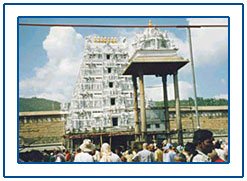 Tirupati,
one of the richest temples in the country,
is the most venerated Vaishnavite shrine of Lord Venkateswara.
It was patronised by the Pallavas, the Cholas, the Pandyas
and the Vijayanagar kings. 130 kms from the city of Madras
(Chennai), this temple is located in the southern Chittoor
district of Andhra Pradesh. Tiru' in Tamil means `Sri'. Hence
Tirupati translates to Sripati or Sri Maha Vishnu.
According to the Puranas, the range of Tirumala hills represent
the body of the serpent Adisesha, on which Lord Vishnu, the
protector of the world, rests. The seven hills represent the
seven heads of the serpent. Tirupati,
one of the richest temples in the country,
is the most venerated Vaishnavite shrine of Lord Venkateswara.
It was patronised by the Pallavas, the Cholas, the Pandyas
and the Vijayanagar kings. 130 kms from the city of Madras
(Chennai), this temple is located in the southern Chittoor
district of Andhra Pradesh. Tiru' in Tamil means `Sri'. Hence
Tirupati translates to Sripati or Sri Maha Vishnu.
According to the Puranas, the range of Tirumala hills represent
the body of the serpent Adisesha, on which Lord Vishnu, the
protector of the world, rests. The seven hills represent the
seven heads of the serpent.
Perched on the 860 m high
peak of the Tirumala hills, the temple is a Dravidian masterpiece.
The splendid Viman or 'Ananda Nilayam' rising
protectively over the sanctum is the most arresting feature
in the temple complex. It is plated with gold, as is the Dwajasthambam,
or the temple flagpost. The innermost enclosure of the three
'prakarams', opened once annually, enshrines the two-metre
high majestic black idol of Lord Venkateswara, bedecked with
priceless glittering jewels, most striking of which is the
diamond crown said to be the costliest in the world.
Some people believe that
the idol of Sri Venkateswara has the attributes
of Vishnu and Shiva, the preserving and the destroying aspects
of the Hindu Trinity. This conception is a happy compromise
appealing at once to the Vaishnavites and Shaivites. The idol
has four arms, two in the rear, one carrying the Shankha or
the conch, and the other the Chakra or the discus, and two
in the front, one in the Abhaya pose and the other resting
on the hip. On both the front arms, the Bhujanga Valaya, or
the girdle of the serpent, an emblem of Shiva can be seen.
People from the Northern parts of India, worship Lord Venkateswara,
as Balaji. It is praised by poets as `Bhuloka Vaikuntha'.
The two very important customs
followed in the temple are anointing the body of the Lord
with camphor (Karpoora), saffron and musk, and offering the
tonsure of hair as a sacrifice to the Lord.The Varahaswami
temple, situated near the Venkateswara temple, on the banks
of Swami Pushkarani tank, is said to be even more ancient.
This shrine is dedicated to Lord Vishnu in the form of Varahaswami.
It is said that the Adi Sesha himself forms the seven hills
on which the temple of the Lord is located.
What
to See:
Kalahasti
Temple: Sri Kalahasti temple, situated 36
km away is famous for its Vayudeva temple, which is the only
shrine of the god of wind in India. Constructed in the 12th
century by the Chola king, Rajarajendra, Vayu is incarnated
as Lord Shiva and worshipped as Kalahasteeswara. The story
goes that the linga here was invoked by a spider (Sri), snake
(Kala) and an elephant (Hasti). Hence the town was aptly referred
to as Sri Kalahasti. Besides Swamypushkarini, there are several
important water-falls in and around Tirumala, namely Akasaganga,
Papavinasanam, Pandava Theertham, Jabili Theertham, Chakra
Theertham, Ramakrishna Theertham, Kumaradhara Theertham and
Tumburu Theertham, each excelling the other in the riddance
of the sins of those who bathe in them.
Narayanavanam:
Located 36 km away is the temple dedicated to Lord Kalyana
Venkateswaraswamy. It is believed that this is the venue of
the sacred marriage between Lord Venkateswara and Goddess
Padmavathi.
Festivals:
Brahmotsavam,
the most important of the various festivals of the temple,
is conducted usually in Bhadrapada i.e., in September for
about 9 days. On account of Adika Masam, which comes in every
third year, a second Brahmotsavam in the month of Aswayuja
(Puratasi) will be held under the name, "Navarathri Brahmotsavam".
These Brahmotsavams attract thousands of pilgrims from various
parts of the country.
Travel
Information:
Direct bus services from
major towns and cities in the south-Madras, Hyderabad and
Bangalore. Nearest railhead is Renigunda (!0 kms). Direct
rail connections to Hyderabad, Vijayawada, Madras, Tiruchirapalli,
Puri and Delhi. Air connections to Bangalore, Hyderabad, Madras
and Vijayawada. |