Varanasi
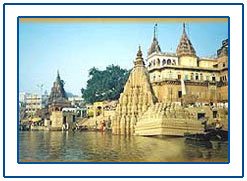
Varanasi
is one of the oldest living cities in the world and the ultimate
pilgrimage for Hindus, who believe that to die in the city
is to attain instant salvation. Varanasi is the tract of holy
land lying between the Ganga and the Assi rivers. The Assi
river also flows into Ganga. Varanasi is also known as Kashi,
the city of light since one of the twelve 'Jyortinglinga's
is installed here. Varanasi has been a great cultural centre,
especially in the fields of music, learning and the craft
of silk weaving.
Places
To See:
Vishwanath
Temple : The Vishwanath temple, or Golden
Temple, is the most sacred temple in Varanasi and is dedicated
to Vishveswara-Shiva as lord of the universe. The original
temple was destroyed by the Mughal Emperor Aurangzeb, and
the present temple was built in 1776 by Rani Ahilyabai of
Indore . 800kg of gold plating on the towers, which gives
the temple its colloquial name, was provided by Maharaja Ranjit
Singh of Lahore some 50 years later.
Benaras
Hindu University : Varanasi has long been
a centre of learning and that tradition is continued today
at the Benaras Hindu University (BHU) built in 1917. It is
considered to be the largest residential university in Asia.
It was founded by the great nationalist Pandit Malaviya as
a centre for education in Indian art, music, culture and philosophy,
and for the study of Sanskrit. The five sq km campus houses
the Bharat Kala Bhavan which has a fine collection of miniature
paintings, sculptures from 1st to 15th centuries.
Tulsi
Manas Temple : Only 150m south of Durga Temple
is the modern marble shikhara-style Tulsi Manas Temple, built
in 1964. Its two tier walls are engraved with verves and scenes
from the Ram Charit Manas, the Hindi version of the Ramayana.
Its author , poet Tulsi Das, lived here while writting it.This
Temple is on the spot where Saint Tulsidas composed the Ramayana
in Hindi (The Ramacharitamanas).
Durga
Temple : The Durga temple is one of the most
important temples in Varanasi and is built in the 18th century,
by Bengali maharani and is stained red with ochre . This temple
is built in north Indian Nagara style with a multi-tiered
shikhara (spire). The shikhara of the temple is formed by
many small spires which are built one on top of the other.
Durga is the 'terrible' form of Shiva's consort Parvati, so
at festivals there are often sacrifices of goats. It is commonly
known as Monkey Temple due to many frisky monkey that have
made it their home.
Ram
Nagar Fort & Museum : On the opposite
bank of river, this 17th century fort is the home of the former
maharaja of Benaras. It looks most impressive from the river,
though the decrepit planking of the pantoon bridge you cross
to reach it is somewhat of a distraction. During the mansoon
access is by ferry. The intresting museum here contains old
silver & brocade palanquins for the ladies of the court,
gold-plated elephant howdahs, an astrological clock, marcabre
elephant traps and an armoury of swords and old guns.
Bharat
Mata Temple : Dedicated to 'Mother India',
this temple has a marble relief map of India instead of usual
images of gods & goddesses. The map is said to be perfectly
in scale, both vertically and horizentally.the temple was
opened by Mahatma Gandhi.
Travel
information:
Air
: Varanasi is connected by air with Delhi,
Agra, Khajuraho, Calcutta, Mumbai, Lucknow, Bhubaneshwar and
Kathmandu.
Rail : Varanasi
is important railway junction having train connections with
all major cities of India .
Road : Varanasi
is connected by road with all parts of the state.

|