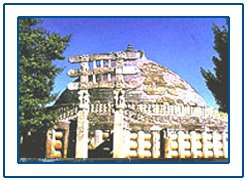
Sanchi, variously known as Kakanaya, Kakanava, Kakanadabota and Bota-Sriparvata in ancient times, has a singular distinction of having remarkable specimen of Buddhist art and architecture right from the early Mauryan period (c. thirth century BC to twelfth century AD).
Sanchi is famous in the world for stupas, monolithic Asokan pillar, temples, monasteries and sculptural wealth. During Sunga times, several edifices were raised at Sanchi and its surrounding hills. The Asokan stupa was enlarged and faced with stones and decorated with blustrades, staircase and a harmika on the top. The reconstruction of Temple 40 and erection of Stupas 2 and 3 also seem to date back around the same time. In the first century BC the Andhra-Satavahanas, who had extended their sway over the eastern Malwa, caused the elaborately carved gateways to Stupa 1.
|
|
From the second to fourth century AD Sanchi and Vidisha came under the Kushanas and Kshatrapas and subsequently passed on to the hands of the Guptas. During the Gupta period some temples were built and sculptures were added. Shrines and monasteries were also constructed at the site during seventh and twelfth centuries AD.
Since the fourteenth century Sanchi remained deserted and uncared for till 1818 when General Taylor rediscovered the site, Sir John Marshall, established an archaeological museum in 1919, which was later transformed into the present site museum at Sanchi.
Presently under an UNESCO project Sanchi and Satdhara, a Buddhist site, 10 km south-east of Sanchi, is being further excavated, conserved and environmentally developed.
.  |